The artwork displayed across this website is part of the collection No6, created by Hilma af Klint (1862–1944), a visionary, artist and mystic, now recognised as a pioneer of purely abstract painting. For much of her life, her work remained unseen. She understood herself to be receiving her paintings rather than inventing them—a process she described as visual dictation from guides she encountered during séances. What we might now call channelling was, for her, a disciplined form of listening.
In 1904, a spirit guide named Gregor instructed her to build a temple in the form of a spiral, where her paintings could be hung together as a single sacred environment. She spent years developing detailed architectural plans for this structure—circular, ascending, with paintings arranged to guide the visitor inward and upward along a spiritual trail. The temple was never built in her lifetime. She died in 1944, having stipulated that her abstract work remain hidden for twenty years, convinced that the world was not yet ready to receive it.
It would take seventy-four years for her vision to find its form. In 2018, the Solomon R. Guggenheim Museum in New York—Frank Lloyd Wright's spiral temple of spirit—mounted Paintings for the Future, the most successful exhibition in the museum's history. Af Klint's paintings ascended the spiral ramp she had dreamed of but never seen. What was held in trust for decades, refused by her contemporaries, was finally encountered by the public in a space that seemed to have been waiting for her.
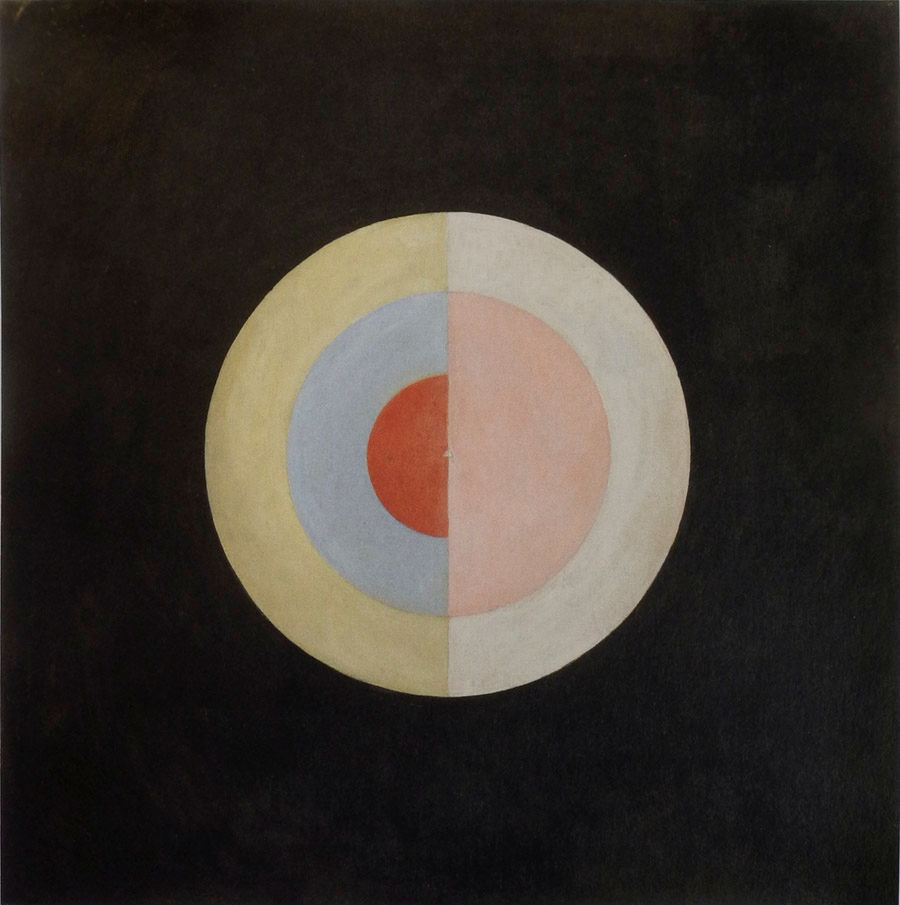
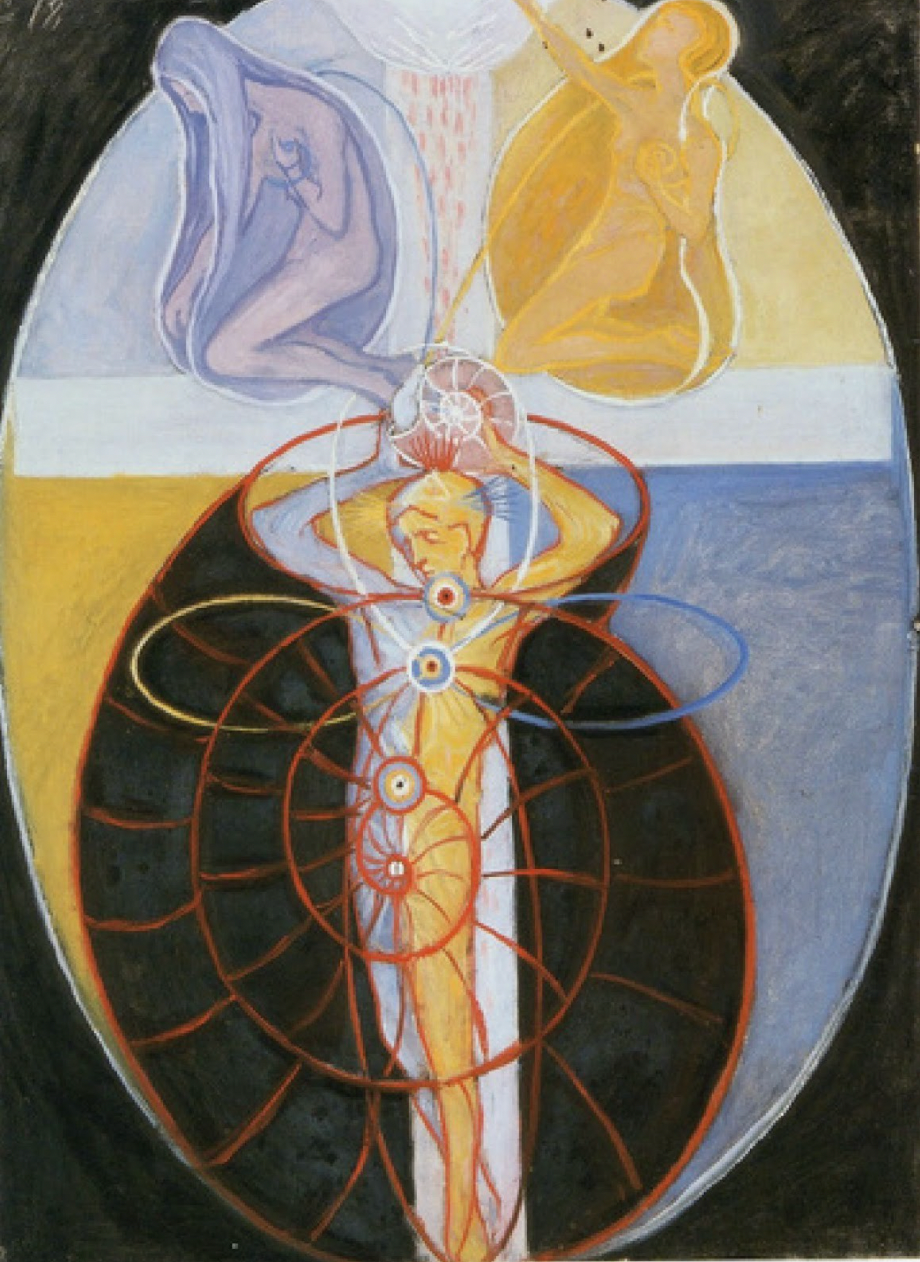
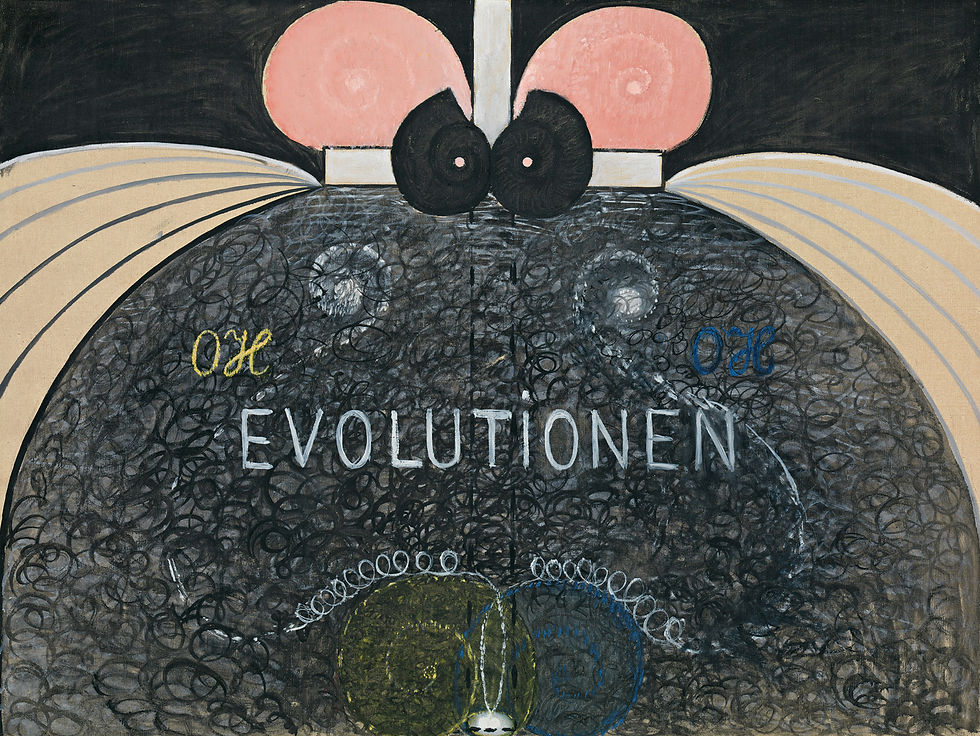
I have chosen images from her Group VI, Evolution series. These paintings attend to transformation—not as sudden rupture, but as slow, spiral unfolding. Forms overlap, separate, and reconfigure. Colours shift between what is visible and what remains partially concealed. The series begins with a figurative image: the human form still present, still embodied, before the paintings move into abstraction. This movement from the recognisable to the symbolic mirrors how I understand therapeutic change. We do not leave ourselves behind. We begin where we are—in the particularity of a body, a history, a set of circumstances—and from there, something else becomes possible.
From a Jungian perspective, af Klint's work can be read as a sustained encounter with the objective psyche: the layer of mind that exists beyond the individual, populated by archetypal forms that structure human experience across time and culture. Her spirals echo the axis mundi, the world tree, the serpent coiled at the base of the spine. Her colours are not decorative but operative—vehicles for spiritual transformation, what she understood as forces that could mediate and channel the unseen. The Evolution series, with its ascent from figuration to pure symbol, traces the individuation process itself: the gradual differentiation of the self from the collective, the emergence of a unique centre of consciousness that remains nonetheless rooted in the universal.





Af Klint's paintings were not made to be looked at quickly. They were made to be inhabited, wandered through, and returned to. This is how I hope this space functions—not as a place to find answers, but as a place where something might emerge, in its own time, through attention and return.